Saturday, July 21, 2012

Chili Oil and Rosemary Oil = Hair growth!

I thought I would share my experience with using chili pepper oil (capsicum) and rosemary essential oil to help aid with hair growth.


For a while I notice my hair was staying at one length (ex. A)
ex. A (2009)
 and it didn't seem to grow past that length for about 3 years. I believe it may have been due to poor managing or stress, who knows but I know for sure I was most certainly getting tired of it remaining that same length for so long! Now, I know black hair shrinks in it's natural state due to the tight curls but even when I straighten it to do a length check I noticed it still had not grew very much. I made sure to moisture it as much as possible, along with protein treatments but it still remained the same.
I finally search the web for remedies and suggestions and that's when I stumble upon information about protective styling and essential oils. For so long I was wetting my hair every morning (to get that "was-n-go" look lol), throwing a LITTLE moisturizer in it and heading out the door. By doing this everyday for such a long period of time I was causing my hair to dry out. Not getting regular trimmings as well added to my tight curls tangling, knotting up and splitting. So I decided I would keep my hair straight for a while so I could avoids knots and tangles and so I could stop the excessive use of water (Only when washing my hair) and keep it oil and protected between trimmings.


ex. B
(Small amount of my real hair left out in the front.)
My protective styles included keeping my hair in a bun and also braiding it back and wearing half wigs...(ex. B). By doing this there was less stress and manipulation done to my hair and it stayed moisturized and protected. At night I made sure to sleep with a satin scarf on my head. Avoiding breakage as much as possible is key (of course lol).


ex. C
Now, I took hair vitamins as well. I suggest Futurebiotics® Hair, Skin & Nails®. Hair, Skin & Nails®...(ex. C). These vitamins worked great for me. Maintaining a healthy diet and taking in the right supplements and vitamins are always good for healthy hair growth.


On to the oil....
I came up with using capsicum and rosemary oil because both I assumed these two oils would help with hair growth due to them both aiding in stimulating nerves and blood flood. 


Chili oil helps ability to improve blood circulation and it is an antioxidant which help to combat free radicals in the body.  "Rosemary (Rosemarinus officinali bps) is a wonderful smelling, multi-purpose herb; the leaves of which have been used in traditional cures for centuries. The herb stimulates hair growth and makes hair smell delightful. Rosemary is said to enhance the memory by improving blood circulation." Learn more: (http://www.naturalnews.com/032781_rosemary_hair.html#ixzz21HdzB0uj).  
" ...known to be good for the hair and scalp. Use as a rinse to condition hair and fight dandruff. Rinsing with a rosemary infusion (strong tea) on a regular basis is thought to encourage growth and may even restore color in some cases. Combine with a few drops of lavender essential oil for best results." (http://www.everygreenherb.com/rosemary2.html). 


ex. D1 (2011)
I decided to mix the two with a small amount of water into a fine tip squeeze bottle and distribute it all throughout my scalp. *Make sure to avoid rubbing your hair and eyes after use*. Once applying you will definitely feel immediate tingling or a little burning but don't worry it will soon subside.  I continued this method for a year and starting noticing more growth and length in my hair. With protective styling, along with using a little of the oil mix directly on my scalp, my hair length showed some significant changes! 
(ex.D1 - D2).


ex. D2 (2011)


Tuesday, June 12, 2012

PROS & CONS of Online Dating!

 I remember not to long ago a lot of people perceived online dating as "taboo" or for those who were "weirdos", "creeps" or "for losers who could not get a date in person." Times have changed and many people's mindset and feelings have changed in regards to online dating. A lot more people from all walks of life are trying it and it  is becoming quiet the norm in the world of dating. More people are a lot more accepting of this new way of meeting people to find a potential mate, friend or random hookup for you know what.

  With so much computer use going on, I think it is only natural that one might eventually stumble across an online dating site and try it out to see what it is like. Some have success and some have failure. That is why it is best for one to weigh the pros and cons of online dating before diving head first into it....

Here is a list of some the Pros & Cons:

PROS

  • HELPS PULL THE WEEDS OUT
      - You can "weed out", eliminate, block those who you are not interested in based on profile picture, what is written on their profile, etc. In person it can be a bit harder to do without being rude (not that you necessarily have to be) or having the other person feel stupid, hurt or embarrassed because you turned them down right in their face.

  • A LOT OF OPTIONS     
     - You can meet a significant amount of people online from the convenience of your home in little time.


  • MORE ANONYMITY MORE OPEN
    - People are a little more comfortable and open when talking because they protected by the computer screen. So this helps making it a bit easier in getting to know someone better in little time.

  • NOT FEELING BAD WHEN TURNED DOWN
   - Rejection doesn't bother or hurt you as much like it does in face-to-face encounters.

  • NOTICE WORDS MORE THAN LOOKS
   - It can go either way. Though we are first drawn or attracted to a person based on looks first, as we talk to someone online or over the phone for a while before meeting in person helps us focus more on what they say and what they feel instead of the distraction of just focusing their physical attributes. As we get to know each other better, if the two people enjoy the conversation and feel they share the same thoughts, they will connect on a better level where the physical characteristics MAY become less important.


CONS


  • MISSING THE REAL
- You may miss out on "real" dating and socializing with people in person, where you can touch, smell, and feel them in person on your first encounter.

  • BEING LOOKED AT HAS STRANGE
  - Even though many people have got hip to online dating, many of those who are not computer savvy or into new ways of dating (Your traditional people), like some friends or relatives, my criticize you for it. Be ready to hear some negative responses when you tell someone that you met a person ONLINE! They'll say you are desperate, dumb, crazy and everything else because they refuse to accept people meeting online.
What they fail to realize is...You can meet crazy people in person too, not just on the internet!

  • LIARS, POSERS, AND EXAGGERATION 
   - A person can be whoever they what to be online. The picture they post may not be of them-fake profile or using an old picture of themselves when they surely don't look like that anymore.Lying about themselves and what they have or making it seem they have this great life and they truly what you to be apart of it. Saying they are single when they are not and saying they want a relationship but actually they are just looking for a quick hookup for sex.


  • ADDICTION AND WASTING TIME 
- You can become so wrapped up and addicted to meeting people online that you forget about other important matters in your life. Sitting on the computer all day and forgetting to go out and socialize in person and having time for friends and family instead of looking at profiles all day hoping to find "The One".

  •  RELOCATION COST
- This depends on if you are not only looking for someone locally. If you live in Iowa and the person you hit it off with and are serious about lives in Texas, are you willing to put in the time and money to go and visit or live with that person? Would you be able to make changes in your life and relocate for "love?".


  • SPENDING ON LOVE
    - Some dating website require you to pay a monthly fee in order to use them because they are trying help you find your best match (Who may turn out not to be when you meet them). Now, are you go to spend money like that hoping that the site will do it's best matching you with the all these potentials who could possibly be "The One" and it turning into a disaster? No! Who wants to waste money like that and never find their match after all that money spent. You could have used it to go out to meet people instead. (Tip: Always try the free sites first. If it doesn't work THEN head over to the ones that charge to help give more in depth matchmaking).


- Jamie

Sunday, June 3, 2012

   
Floating free as a feather....


Letting go of past hurt or feelings that caused us so much grief and sorrow (like lose of a loved one) may be hard but if you hold on to them you will remain stuck and never moving forward. Simply trapped. We must set ourselves free from   these bad feelings. Making better progress in life starts with setting our minds on starting something new, new goals that we know will help in the future. Remaining in the past with negative thoughts causes you to miss out on your blessing that will bring you happiness in the present and in the near future.
The freedom of letting go.


Let go, free your mind, and be at peace.Focus on tomorrow, you only have one life and it is precious. Enjoy the good things and those to come. The past is over look at now and what's to come. 


  No worries.

Wednesday, April 11, 2012

Verbal Abuse

    I enjoyed Spring break with the kids, relaxed and chilled in the nice Cali weather. Now back to business!


Never let another's negative words affect
how you feel about yourself.
   This post is about dealing with verbal abuse and negativity.

    All of us at sometime in our lives or throughout our lives have endured the pains of abuse. Whether it be from a co-worker, friend, relative or a complete stranger, no matter what it always has some kind of affect on us. It will mess with your self-esteem, confidence, fears and/or future relationship with others if you try to ignore it or just "brush it under the rug", it sticks! 


    Though constructive criticism may be useful sometimes when trying to help someone better themselves,  it must be done with tact. It is not what you say but how you go about saying...If I say, "Your dress makes you look fat and boxy!", it is going to get a negative reaction from the individual that I am saying it to. Now, if I say, "You know you have great figure and that dress is really covering it up! I think you would look good in a more figure flattering dress best for your nice shape", then I might proceed to help the person look for some clothing that will look better and more complimentary to their body. See the difference! It is all about how you say it. Not everyone will be tactful like that though so you have to have tough skin.

    
      Some people may just be more blunt than others and say stuff right off the top of their head and may not think things through but their intentions may have not been coming from a negative place. This is when we must differentiate whether this pure negativity, coming from a hateful and spiteful place or just honest constructive criticism used to be helpful. 


     Many of us are subject to verbal abuse and are unaware, feeling it is just "harmless mean words" (which would be an oxymoron) thinking it is OK to deal with day to day when it should NOT be! If you are constantly dealing with this from a person all the time then most likely they are being verbally abusive. Some people have to endure this so much that it becomes the norm for them, almost believing they deserve it-when they don't. Here are some signs that you are dealing with a verbal/emotional abuser:


  • Name calling
  • Ridicule over self expression
  • Jealousy over friends or family
  • Belittling your concerns or needs
  • Berates your self confidence
  • Says, "You're Too Sensitive"
  • Gives you the silent treatment for unclear reasons
  • Making impossible demands
  • Outbursts of rage for no clear reason
  • Frequent criticism or humiliation
  • Makes fun of you in front of others


(A person may even do these above in a joking manner but it is still WRONG. Verbal abusers seek control, and not just your actions but your emotions as well.)


   Remember to never put up with such abuse, life is to short to feel miserable because another person is unhappy with themselves and wants you to feel like crap too. Never give them power, it will eventually weaken and drain you!


    Here are some articles that are helpful when trying to overcome hurt and pain of dealing with negativity:


Hope it will be of great use to you :-)


Have a blessed day.

Wednesday, February 8, 2012

Macarons!


Coconut Macaroons
I was watching some of Michelle Phan's vids and I was inspired to write a post on Macarons (The spelling is correct, don't confusion them with your coconut macaroons). If you don't know what they are, macarons are french pastries filled with butter cream or jam filling sandwiched between two cookies. It has been argued that macarons originated in Italy but that's an issue I'll leave alone lol.


Now! If you are interested in making these tasty treats, then here is the recipe for you, enjoy!:


Ingredients

  • 1 1/4 cups plus 1 teaspoon confectioners sugar
  • 1 cup (4 ounces) finely ground sliced, blanched almonds
  • 6 tablespoons fresh egg whites (from about 3 extra-large eggs)
  • Pinch of salt
  • 1/4 cup granulated sugar
  • Macaron Filling

              Directions

  1. To make the macarons: Preheat the oven to 350 degrees. In a medium bowl, whisk together confectioners' sugar and ground almonds. In the bowl of an electric mixer fitted with the whisk attachment, whip egg whites with salt on medium speed until foamy. Increase speed to high and gradually add granulated sugar. Continue to whip until stiff glossy peaks form. With a rubber spatula, gently fold in the confectioners' sugar mixture until completely incorporated.
  2. Line baking sheets with parchment paper; set aside. Fit a pastry bag with a 3/8-inch #4 round tip, and fill with batter. Pipe 1-inch disks onto prepared baking sheets, leaving 2 inches between cookies. The batter will spread a little. Let stand at room temperature until dry, and a soft skin forms on the tops of the macarons and the shiny surface turns dull, about 15 minutes.
  3. Bake, with the door of the oven slightly ajar, until the surface of the macarons is completely dry, about 15 minutes. Remove baking sheet to a wire rack and let the macarons cool completely on the baking sheet. Gently peel off the parchment. Their tops are easily crushed, so take care when removing the macarons from the parchment. Use immediately or store in an airtight container, refrigerated for up to 2 days or frozen for up to 1 month.
  4. To fill the macarons: Fill a pastry bag with the filling. Turn macarons so their flat bottoms face up. On half of them, pipe about 1 teaspoon filling. Sandwich these with the remaining macarons, flat-side down, pressing slightly to spread the filling to the edges. Refrigerate until firm, about 1 hour.
  5. Variations: To make coffee-flavored macarons: In step 1, add 2 drops brown food coloring to the egg whites after they are whipped. In step 4, blend 1/2 cup macaron filling with 1 1/2 teaspoons espresso powder dissolved in 1/2 teaspoon warm water for the filling. To make cassis-flavored macarons: In step 1, add 2 drops purple food coloring to the egg whites after they are whipped. In step 4, use 1/3 cup good-quality cassis jam for the filling. To make pistachio-flavored macarons: In step 1, add 2 drops green food coloring to the egg whites after they are whipped. In step 4, combine 1/2 cup macaron filling with 1 tablespoon pistachio paste for the filling.


Sunday, February 5, 2012

Black History Month

Americans have recognized black history annually since 1926, first as "Negro History Week" and later as "Black History Month." What you might not know is that black history had barely begun to be studied-or even documented-when the tradition originated. Although blacks have been in America at least as far back as colonial times, it was not until the 20th century that they gained a respectable presence in the history books.

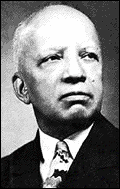
Blacks Absent from History Books We owe the celebration of Black History Month, and more importantly, the study of black history, to Dr. Carter G. Woodson. Born to parents who were former slaves, he spent his childhood working in the Kentucky coal mines and enrolled in high school at age twenty. He graduated within two years and later went on to earn a Ph.D. from Harvard. The scholar was disturbed to find in his studies that history books largely ignored the black American population-and when blacks did figure into the picture, it was generally in ways that reflected the inferior social position they were assigned at the time.

Established Journal of Negro History Woodson, always one to act on his ambitions, decided to take on the challenge of writing black Americans into the nation's history. He established the Association for the Study of Negro Life and History (now called the Association for the Study of Afro-American Life and History) in 1915, and a year later founded the widely respected Journal of Negro History. In 1926, he launched Negro History Week as an initiative to bring national attention to the contributions of black people throughout American history.
Woodson chose the second week of February for Negro History Week because it marks the birthdays of two men who greatly influenced the black American population, Frederick Douglass and Abraham Lincoln. However, February has much more than Douglass and Lincoln to show for its significance in black American history. For example:
  • February 23, 1868:
    , important civil rights leader and co-founder of the NAACP, was born.
  • February 3, 1870:
  • February 25, 1870:
  • The first black U.S. senator, Hiram R. Revels (1822-1901), took his oath of office.
  • February 12, 1909:
  • February 1, 1960:
  • In what would become a civil-rights movement milestone, a group of black Greensboro, N.C., college students began a sit-in at a segregated Woolworth's lunch counter.
  • February 21, 1965:
    , the militant leader who promoted Black Nationalism, was shot to death by three Black Muslims.


Read more: The History of Black History Month (Famous People, Women, Facts, Leaders, Events) — Infoplease.com http://www.infoplease.com/spot/bhmintro1.html#ixzz1lZcVL8XD 

Valentine's Day History....

The Legend of St. Valentine

The history of Valentine's Day--and the story of its patron saint--is shrouded in mystery. We do know that February has long been celebrated as a month of romance, and that St. Valentine's Day, as we know it today, contains vestiges of both Christian and ancient Roman tradition. But who was Saint Valentine, and how did he become associated with this ancient rite. 
The Catholic Church recognizes at least three different saints named Valentine or Valentinus, all of whom were martyred. One legend contends that Valentine was a priest who served during the third century in Rome. When Emperor Claudius II decided that single men made better soldiers than those with wives and families, he outlawed marriage for young men. Valentine, realizing the injustice of the decree, defied Claudius and continued to perform marriages for young lovers in secret. When Valentine's actions were discovered, Claudius ordered that he be put to death.
Other stories suggest that Valentine may have been killed for attempting to help Christians escape harsh Roman prisons, where they were often beaten and tortured. According to one legend, an imprisoned Valentine actually sent the first "valentine" greeting himself after he fell in love with a young girl--possibly his jailor's daughter--who visited him during his confinement. Before his death, it is alleged that he wrote her a letter signed "From your Valentine," an expression that is still in use today. Although the truth behind the Valentine legends is murky, the stories all emphasize his appeal as a sympathetic, heroic and--most importantly--romantic figure. By the Middle Ages, perhaps thanks to this reputation, Valentine would become one of the most popular saints in England and France.
                         

Origins of Valentine's Day: A Pagan Festival in February
While some believe that Valentine's Day is celebrated in the middle of February to commemorate the anniversary of Valentine's death or burial--which probably occurred around A.D. 270--others claim that the Christian church may have decided to place St. Valentine's feast day in the middle of February in an effort to "Christianize" the pagan celebration of Lupercalia. Celebrated at the ides of February, or February 15, Lupercalia was a fertility festival dedicated to Faunus, the Roman god of agriculture, as well as to the Roman founders Romulus and Remus. 
To begin the festival, members of the Luperci, an order of Roman priests, would gather at a sacred cave where the infants Romulus and Remus, the founders of Rome, were believed to have been cared for by a she-wolf or lupa. The priests would sacrifice a goat, for fertility, and a dog, for purification. They would then strip the goat's hide into strips, dip them into the sacrificial blood and take to the streets, gently slapping both women and crop fields with the goat hide. Far from being fearful, Roman women welcomed the touch of the hides because it was believed to make them more fertile in the coming year. Later in the day, according to legend, all the young women in the city would place their names in a big urn. The city's bachelors would each choose a name and become paired for the year with his chosen woman. These matches often ended in marriage.
                           Valentine's Day: A Day of Romance
Lupercalia survived the initial rise of Christianity and but was outlawed—as it was deemed “un-Christian”--at the end of the 5th century, when Pope Gelasius declared February 14 St. Valentine's Day. It was not until much later, however, that the day became definitively associated with love. During the Middle Ages, it was commonly believed in France and England that February 14 was the beginning of birds' mating season, which added to the idea that the middle of Valentine's Day should be a day for romance.Valentine greetings were popular as far back as the Middle Ages, though written Valentine's didn't begin to appear until after 1400. The oldest known valentine still in existence today was a poem written in 1415 by Charles, Duke of Orleans, to his wife while he was imprisoned in the Tower of London following his capture at the Battle of Agincourt. (The greeting is now part of the manuscript collection of the British Library in London, England.) Several years later, it is believed that King Henry V hired a writer named John Lydgate to compose a valentine note to Catherine of Valois.

Source: http://www.history.com/topics/valentines-day

Friday, January 13, 2012

MY BIRTHDAY!!!!

It is around the corner!!

So I leave you with my natal chart.....

Thursday, November 3, 2011

My MtDNA - Haplogroup L2a

IntroductionL2 is the most common haplogroup among both Africans and African Americans. It arose about 95,000 years ago, but did not reach its predominance in Africa until much more recently, when Bantu-speaking populations began moving east and south from the vicinity of present-day Cameroon. That migration, which began about 4,000 years ago and lasted into historical times, reshaped the continent's genetic landscape by dramatically expanding the range of L2 and other western African haplogroups. L2a, which dates back about 55,000 years, is present in 20% or more of both Africans and African Americans.

L2 is found among African Americans whose ancestors were transported from West African slave centers.

L2a and the Bantu ExpansionHaplogroup L2a is extremely common among the vast majority of Africa south of the Sahara. In f`act, it is so widespread and diverse that it has been difficult to pinpoint where in Africa it arose. However, current thinking puts the origins of L2a somewhere in Central Africa. At the peak of the Last Ice Age 20,000 years ago, when the Sahara Desert became entirely uninhabitable and began expanding to the south, people bearing Haplogroup L2a began journeying in two directions: east toward the cooler climate of the eastern highlands, and west towards the Atlantic coast.But this ancient expansion was not to be the last in the history of L2a. Beginning about 4,000 years ago, two sub-branches of L2a — L2a1a and L2a1b — were swept up with the Bantu-speaking people of West Africa. These people, who had been practicing farming for a millennium or more, began to expand their territory and gradually introduced both their language and their way of life to their eastern and southern neighbors. Today, both L2a1a and L2a1b are well-represented in Southeast Africa, and L2a reaches levels of 36% in the southeastern African nation of Mozambique.While for the most part the barrier of the Sahara Desert prevented L2a from expanded into North Africa, the haplogroup has been found in about 4% of Tunisians. This suggests that at least a few people bearing L2a managed to cross the harsh desert.
A Transatlantic ConnectionHaplogroup L2a is also common in the Americas. In fact, it is the most common haplogroup among African-Americans, reaching levels of 20%.The high frequency of L2a among African Americans is probably due to its concentration in West Africa, which was the main supply region for the Atlantic slave trade. The vast majority of African Americans bear a type of L2a that is found only in West Africa. L2a also made its way to South America through the slave trade; today a branch of L2a, L2a1, is found in up to 40% in some Afro-Brazilian populations.In the Spittoon...What can genetics reveal about African American ancestry? Find out at the Spittoon.
L2a in EuropeAlthough it is extremely rare in Europe, haplogroup L2a has been found among a small number of people there, mostly in the eastern part of the continent. It is most common among Ashkenazi Jews from Poland, but has also been found among Romanian, French, German and Russian Jews and non-Jewish Slavs in Slovakia and the Czech Republic.The distribution of L2a in Europe makes it very difficult to determine exactly how and when the haplogroup first appeared on the continent; but genetic analyses indicate that a migration from Africa during the Ice Age, more than 10,000 years ago.Source: https://www.23andme.com/you/haplogroup/maternal`

Wednesday, October 26, 2011

Pumpkins!


Since Halloween is around the corner and pumpkins are in abundance right now, I guess I will leave some fun facts about pumpkins! (I know...boring, right but I had nothing else to think of lol).

So here are the facts on your plumb and wonderful pumpkins that we all soooo enjoy carving and eating for the holidays:


  • The word pumpkin originates from the word pepon, which is Greek for “large melon". The French adapted this word to pompon, which the British changed to pumpion and later American colonists changed that to the word we use today, "pumpkin". 


  • The origin of pumpkins is not definitively known, although they are thought to have originated in North America. The oldest evidence, pumpkin-related seeds dating between 7000 and 5500 BC, were found in Mexico. Pumpkins are a squash-like fruit that range in size from less than 1 pound (0.45 kilograms) to over 1,000 pounds (450 kilograms).


  • A pumpkin is a gourd-like squash of the genus Cucurbita and the family Cucurbitaceae (which also includes gourds). It commonly refers to cultivars of any one of the species Cucurbita pepo,Cucurbita mixta, Cucurbita maxima, and Cucurbita moschata, and is native to North America. They typically have a thick, orange or yellow shell, creased from the stem to the bottom, containing the seeds and pulp.


  • The color of pumpkins is derived from the orange pigments abundant in them. The main nutrients are lutein and both alpha and beta carotene, the latter of which generates vitamin A in the body.


Yum!


  • When ripe, the pumpkin can be boiled, baked, steamed, or roasted. In its native North America, it is a very important, traditional part of the autumn harvest, eaten mashed and making its way into soups and purees. Often, it is made into pie, various kinds of which are a traditional staple of the Canadian and American Thanksgiving holiday. In Mexico and the U.S., the seeds are often roasted and eaten as a snack.


  • Pumpkin seeds have many health benefits, as they are a good source of protein, zinc, and other vitamins, and they are even said to lower cholesterol. One gram of pumpkin seed protein contains as much tryptophan as a full glass of milk. Pumpkin seeds are a good source of magnesium,manganese, phosphorus, and phytosterols.


  • Pumpkin seed oil contains essential fatty acids that help maintain healthy blood vessels, nerves and tissues


  • Canned pumpkin is often recommended by veterinarians as a dietary supplement for dogs and cats that are experiencing digestive problems. The high fiber content helps to aid proper digestion. Raw pumpkin can be fed to poultry, as a supplement to regular feed, during the winter to help maintain egg production, which usually drops off during the cold months.


  • The medicinal properties of pumpkin include anti-diabetic, antioxidant, anti-carcinogenic, and anti-inflammatory.


  • East China Normal University research on type-1 diabetic rats, published in July 2007, suggests that chemical compounds found in pumpkin promote regeneration of damaged pancreatic cells, resulting in increased bloodstream insulin levels. According to the research team leader, pumpkin extract may be "a very good product for pre-diabetic people, as well as those who already have diabetes," possibly reducing or eliminating the need for insulin injections for some type-1 diabetics. It is unknown whether pumpkin extract has any effect on diabetes mellitus type 2, as it was not the subject of the study.
  • In the United States, the carved pumpkin was first associated with the harvest season in general, long before it became an emblem of Halloween. A lit jack-o'-lantern as part of the festivities that encourage kids and families to join together to make their own jack-o-lanterns.Not until 1837, does jack-o'-lantern appear as a term for a carved vegetable lantern, and the carved pumpkin lantern association with Halloween is recorded in 1866.With folklore the jack-o-lantern connects to Halloween lore about warding off demons.


             ...............................


Source:
"Pumpkin May Cut Injections for Diabetes". Daily Telegraph(London, UK: Telegraph Group). 9 July 2007. Retrieved 2008-10-02.
History of Half-Moon Bay Pumpkin Festival
"The Pumpkin Patch'," 2007. Halloween Online. 19 Feb. 2008 <http://www.pumpkin-patch.com>.
Levin, Rachel (2008-09-17). "The Power of Pumpkin in All Its Parts". feature article. The Food Paper. Retrieved 2008-10-14.


(You can google more facts and info by yourself and with your kids)


Have a great day!

Saturday, October 15, 2011

DIY Minnie Mouse Ears


Materials:
  • Black Felt
  • Two circular Styrofoam (In whatever size of your choice)
  • Black pipe cleaner sticks 
  • Glue gun with glue sticks
  • Scissors
  • Plastic Headband
  • A bow (buy one already made or make your own out of desired ribbon)
  • Rhinestone 2mm (any size will do, your choice)
  • Sequins


(ex. 3)


Getting started

  1. Cut two circles from the black felt that are the same size has the circular Styrofoam. Do this for both ears. 
  2. Heat up your glue gun and glue the black felt to both sides of the Styrofoam. Make sure to glue around thoroughly so that the foam is fully covered. Trim any excess black felt sticking up.
  3. Next, take two pipe cleaner sticks and wrap them around the ears, twist together to secure them. Put a little drop of hot glue on the pipe cleaner sticks to secure them in place (in SOME spots only not all the way around.)
  4. (ex. 4)
  5. Now take the plastic headband and slide both ears one at a time on the headband through a small opening between pipe cleaner stick and felt ears. Slide the ears to your desired spot and hold them in place then use hot glue to secure them on the headband.
  6. Take your bow and glue it between the ears, add a little glue at the corners of the bow and glue to the ears for extra support. You can also tie some ribbon onto the headband between both ears. 
  7. You can decorate your bow with rhinestones or sequins if you like, your choice. *Best to do this before gluing onto headband. (Optional)
Now you are done! Yeah!

Finished look....


Monday, October 10, 2011

Crispy Honey BBQ wings!


Recipe

  • BBQ sauce (your choice)
  • Chicken wings
  • Brown sugar
  • Pepper
  • Garlic Salt
  • Cayenne Pepper
  • Honey
  • Cooking oil (I used a mix of Olive oil and corn oil)
  • Corn starch or flour (you can mix like I did)
  • Jerk seasoning (just a little pinch)

Clean chicken wings then coat in seasoned flour or cornstarch. Heat oil to medium high. Add chicken and let fry until golden brown. When finished frying, let fried chicken dry and soak up excess oil on a paper towel. 

Prepare honey bbq sauce. Add barbeque sauce in mixing bowl with honey, a little garlic salt, brown sugar, a pinch of cayenne, jerk seasoning (optional) and pepper. Mix together of course ;-)

Add fried chicken in honey bqq sauce mix, coat thoroughly and set each piece aside in serving plate.

Now you are done!

Enjoy :-)

Friday, October 7, 2011

Got my 23andme Genealogy Kit!

Yeah! Now all I have to do is get my paternal dna. I have the results for my mothers side MtDNA - Mitochondrial DNA. My mother's side had highest matches with people of Cameroon and other West African countries such as Ghana and Sierra Leone. For European ancestry, there were a lot of matches with Spain and Portugal (Slave Trade). It is great being able to find out where your ancestors originally came from and what country of origin my African ancestors are from.

With this free test I received from 23andme I can finally get my father's side, through my brother's dna results. I can't wait for the results! Thanks 23andme.


Saturday, October 1, 2011

Macy*s Passport Glamorama 2011 - ~Artrageous~

Volunteered September 23, 2011 for the Macy*s Passport Glamorama by APLA. The theme was "Artrageous", there were many different types of art displayed at the after-party that had fashion design inspired looks.


I had a really fun time there and I hope to volunteer again next year.

Monday, September 19, 2011

Sweet & Sour Chicken

Yesterday I made some sweet and sour chicken
(<picture to left) with jasmine rice. Well....it is gone now!

That's all :-)

"Mmmm"


Recipe:

  • Chicken breast (cut into pieces)
  • Cornstarch
  • Vinegar
  • Soy sauce
  • Egg
  • Brown Sugar/White Sugar
  • Salt/Pepper
  • Ketchup 
  • Oyster Sauce
  • Green bell pepper
  • Onion 
  • Vegetable Oil (any oil of your choice)
  • (La Choy Sweet & Sour sauce)
*(Mix ketchup, sugar, oyster sauce, vinegar and soy sauce in small sauce pan on stove add a little cornstarch and let simmer.)

Heat oil in pot.
Add a little salt and pepper to cornstarch.
Coat chicken pieces in egg first and then cornstarch-set aside on a plate.
Proceed to add coated chicken to hot oil.
When fried chicken pieces turn a crunchy texture with yellow/golden color, remove from pot and let soak on a paper towel.

Heat pan with a little oil and saute green bell pepper and onion until softened.
Add homemade sweet & sour mix along with La Choy Sweet & Sour sauce and chicken.
Saute and mix together thoroughly until sauce thickens and is fully coated on chicken.

Voila!

*Serve with rice

Enjoy!